The ECJ’s Betaal Garant Decision: Good Outcome, Problematic Reasoning

AI generated image
Earlier this July, the European Court of Justice entered the debate over what constitutes a payment service under the Second Payment Services Directive (PSD2), arguably the world´s most influential framework for payments regulation. The decision in Case C-51, Betaal Garant Nederland CV v De Nederlandsche Bank NV reaches the right outcome for the case at hand, but instead of providing the clarity that it purports, it introduces new questions that muddy the waters about activity-based regulation and what constitutes a payment service in the European Union, potentially making life easier for firms trying to avoid payment-services regulation.
The facts of the case
The Dutch referring court asked the ECJ for a preliminary ruling in a dispute between the Central Bank of the Netherlands (DNB) and Betaal Garant, a company that provides guarantees and security deposits in connection with building construction projects.
In a nutshell, the Central Bank imposed periodic penalty payments on Betaal Garant for alleged infringement of the legislation that transposes PSD2 into Dutch Law. More specifically, the Central Bank contends that Betaal Garant exercised the activity of a payment service provider without authorization. The question before the ECJ was therefore whether the Central Bank of the Netherlands was correct in their view that the service rendered by Betaal is a payment service, more specifically, whether “a service of receipt and forwarding of funds provided by an entity acting as an intermediary constitutes a ‘payment service’ (…) and more specifically a ‘credit transfer’, where, in the context of an agreement concluded with a client and a contractor, that entity receives the client’s funds into the payment account of a foundation which is linked to it and then transfers them to the contractor from that account, with the client’s consent”.
For full context, the security deposit product rendered by Betaal Garant looks essentially as shown in diagram 1 below:
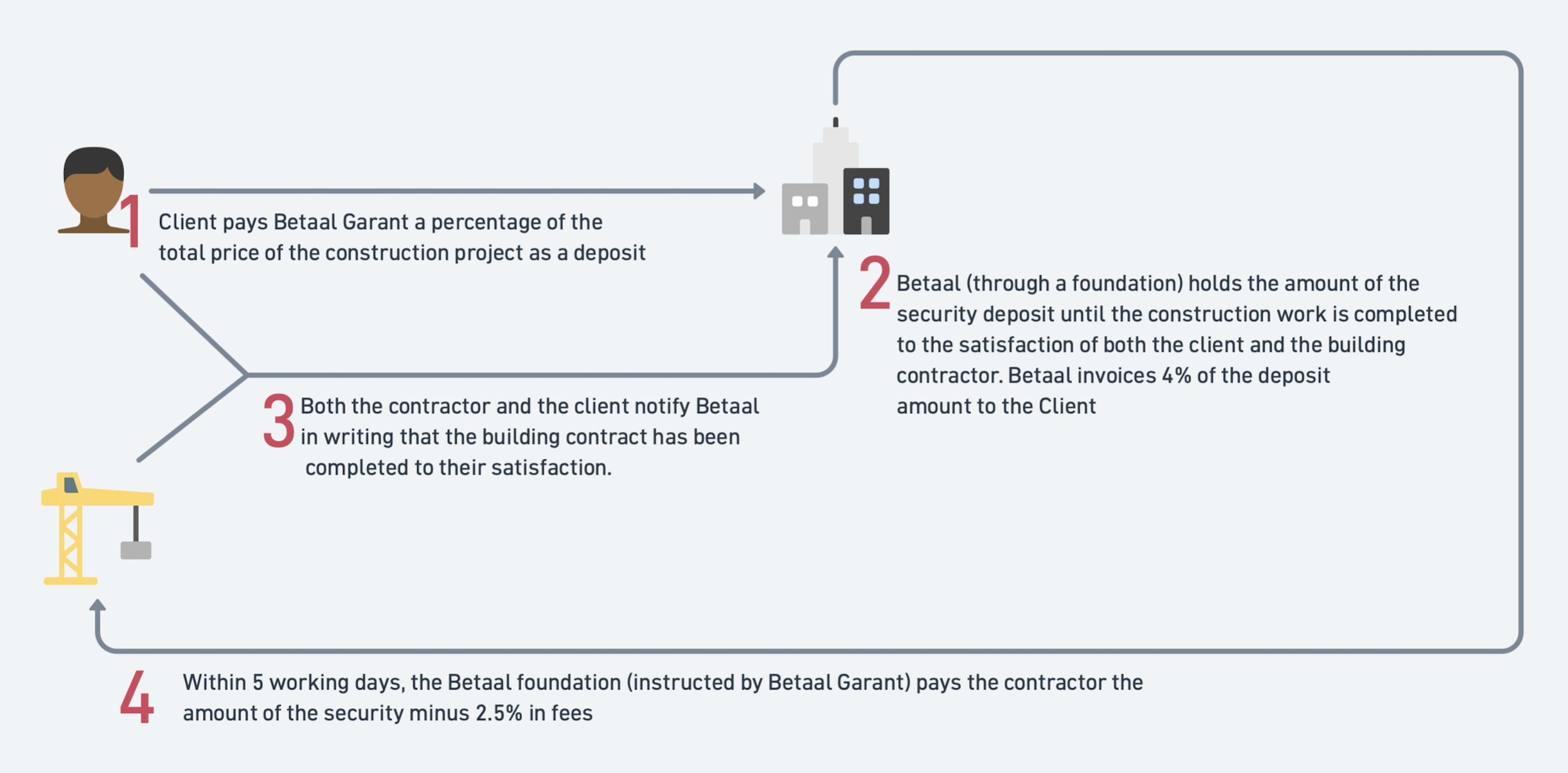
Diagram 1
The ECJ decision:
The ECJ decided that the services rendered by Betaal Garant do not constitute payment services. The core of the reasoning is that Betaal Garant was not executing “credit transfers” because, in the Court’s view, that payment service presupposes that the relevant provider also holds the payer’s payment account. In the words of the Court: “It follows that, in order for a credit transfer to be executed, not only must the payer issue a payment order to his or her payment service provider, but that provider must also hold the payer’s payment account”.
Why is this a problematic decision?
All in all, the ECJ achieved the right outcome for this particular case. The issue is that it reached that conclusion by stating certain things that create uncertainty about the scope of PSD2 in the context of services that involve regular intermediation between a payer and payee. In particular, the Court’s reasoning seems to reopen questions that European regulators had largely settled: how to treat intermediaries that contract with both payers and payees, habitually take possession of payer funds, and then pass those funds on to the payee.
The first problematic statement of the court is this:
“In the present case, although the guarantee and/or security deposit service offered by Betaal Garant involve, inter alia, transfers of funds in the context of the two sub-transactions referred to in (…) it is apparent from the information in the request for a preliminary ruling that those transfers are carried out by the respective banks of the client and the Betaal Garant Foundation, and not by Betaal Garant itself. According to that information, those banks constitute ‘payment service providers’ within the meaning of Article 4(11) of Directive 2015/2366”.
It follows that, the ECJ goes on:
“in the context of the two sub-transactions described (…) above, the execution of payment transactions and credit transfers falls under the responsibility of the respective payment service providers of the client and the Betaal Garant Foundation, without the underlying contractual relationship between the client, Betaal Garant and the contractor having any bearing in that regard.”
The difficulty with that statement is that it revives an argument that has long been used to narrow PSD2’s reach: if banks technically execute the transfers, why treat the intermediary as providing a payment service at all? To understand the point, let’s think of online marketplaces such as eBay or Deliveroo that intermediate between sellers and buyers in the way shown in diagram 2 below:
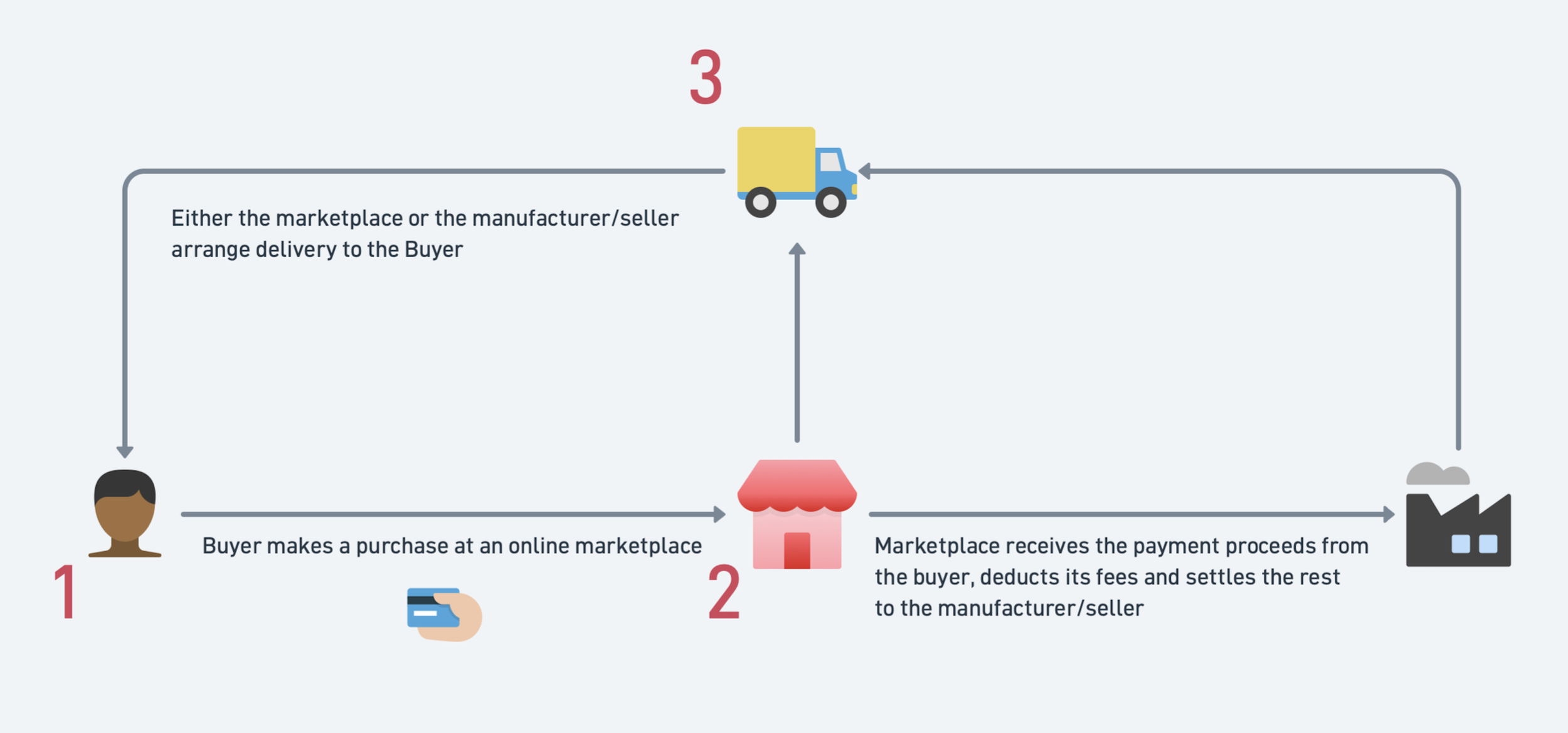
Diagram 2
Applied too broadly, the ECJ’s reasoning reopens the door for smart litigators to argue that PSD2 does not apply to marketplaces operating on this kind of fund flow, because the buyers (the payers in this context) hold their payment accounts with their own banks, not with the marketplace itself. Extending the Betaal logic to these scenarios lends some merit to the argument that there is no payment service whenever the payment transaction is initiated from a payment account that is not held with the intermediary itself. After all, “the execution of the payment transactions and credit transfers fall under the responsibility of the payment service providers” of the buyer and the seller. In fact, in the case of online marketplaces, the Betaal reasoning allows a smart litigator to go one step further: the argument practically writes itself. My client does not hold the buyer’s payment account, and it has hired a licensed payment service provider (Adyen, Stripe, PayPal, Klarna, or another provider) to initiate and process the transaction. The payment proceeds are settled to the account of the Seller held by a bank.
The second and perhaps most problematic statement of the court goes beyond credit transfers to make the broader suggestion that PSD2 applies only where the relevant entity’s regular occupation or business activity is itself the provision of payment services: ¨As regards, in the second place, the context of the provisions at issue, it must be borne in mind that Article 1(1) of Directive 2015/2366 establishes six categories of payment service providers. Those categories include, inter alia, credit institutions, electronic money institutions, payment institutions and post office giro institutions. As is apparent in particular from Article 4(24) of that directive and from point 3 of Annex I thereto, Directive 2015/2366 is intended to apply to payment services and credit transfers which are provided only by entities falling within those categories of payment service providers (…) That interpretation is supported by recital 24 of that directive, according to which the application of the legal framework established by that directive should be confined to service providers who provide payment services as a regular occupation or business activity”.
This line of reasoning is problematic because it invites the argument that marketplaces operating as described in diagram 2 are not payment service providers at all. Their “regular occupation or business activity,” the argument would go, is not payments but food delivery, online retailing, or whatever one-line description best fits eBay’s or Deliveroo’s business model. In other words, a business could habitually enter into possession of payer funds and transfer those funds to payees while avoiding a payment licence by portraying the payment services involved as merely ancillary to its main business. That is hard to reconcile with the more pragmatic activity-based approach taken by regulators such as BaFin, which has focused on substance over form: what matters is not how an online marketplace describes its main business, but the concrete facts of how it operates, including whether it takes possession of payer funds before passing them on. The Central Bank of the UAE put it very well in recent guidance: What matters is whether firms engage or present themselves to engage in activities that are in scope of financial regulation. And let’s not forget that in the European Union this issue is so settled that pretty much every online marketplace that matters has a licensed payment institution to route the funds in transit from the buy-side to the sell-side of their marketplace: We have Takeaway.com Payments B.V. and Uber Payments B.V. in the Netherlands, Amazon Payments Europe S.C.A, and Airbnb Payments Luxembourg S.A in Luxembourg and Delivery Hero Payments S.A in Greece, to name a few.
It is particularly disappointing that the ECJ has reopened these questions because the Betaal case was not especially difficult. A more careful examination of Betaal Garant’s services (as shown in diagram 1 above) would have allowed the Court to point out certain nuances of the case at hand that led to the same result. For example, Betaal does not enter into possession of the full price of the construction work, so it is not really acting as an executor of the payment obligation between the client and the contractor but as a mere guarantor of a slice (6%) of it. The ECJ could have also made use of the obvious policy consideration that Betaal´s clients (and the contractors working for them) are choosing its services with a clear understanding that Betaal will act as a guarantor of a payment obligation, which presupposes trust in Betaal’s solvency for the duration of lengthy construction projects. By contrast, in the marketplace model described in Diagram 2, payees/sellers do not rely on the marketplaces as guarantors of payment obligations that may (or may not) become due in the future. They rely on them as intermediaries who enter into possession of funds corresponding to payment obligations of payers/buyers which are already due and are not contingent on the satisfactory completion of a lengthy construction project. That would have been enough to hold that Betaal’s services deserve a different regulatory treatment than the one contemplated for a Paypal or a Deliveroo (operating as set out in Diagram 2).
The ECJ could have reached the same sensible outcome by focusing on what made Betaal Garant’s service unusual. Instead, it used language broad enough to reopen debates that regulators had good reasons to treat as settled. It will be interesting to see the impact of the decision in future disputes between European regulators and firms that wish to avoid payments regulation despite habitually entering into possession of payers’ funds. With Betaal, the ECJ might have put into question the “same activity, same risk, same rules” principle that is a cornerstone of the EU digital Finance Strategy. Regulators may find it harder to supervise businesses which commercial activities resemble payments services and expose EU Consumers and Businessess to the risks generated by payment services, but label themselves as something else.
Disclaimer: This does not constitute legal advice but mere commentary on the ECJ decision. The views expressed in this article are my own and do not represent the views of my employers or any third parties.
Read more:
Here is another interesting take about the “ancillary services” issue by Alexander Glos and Alicia Hildner from Freshfields.