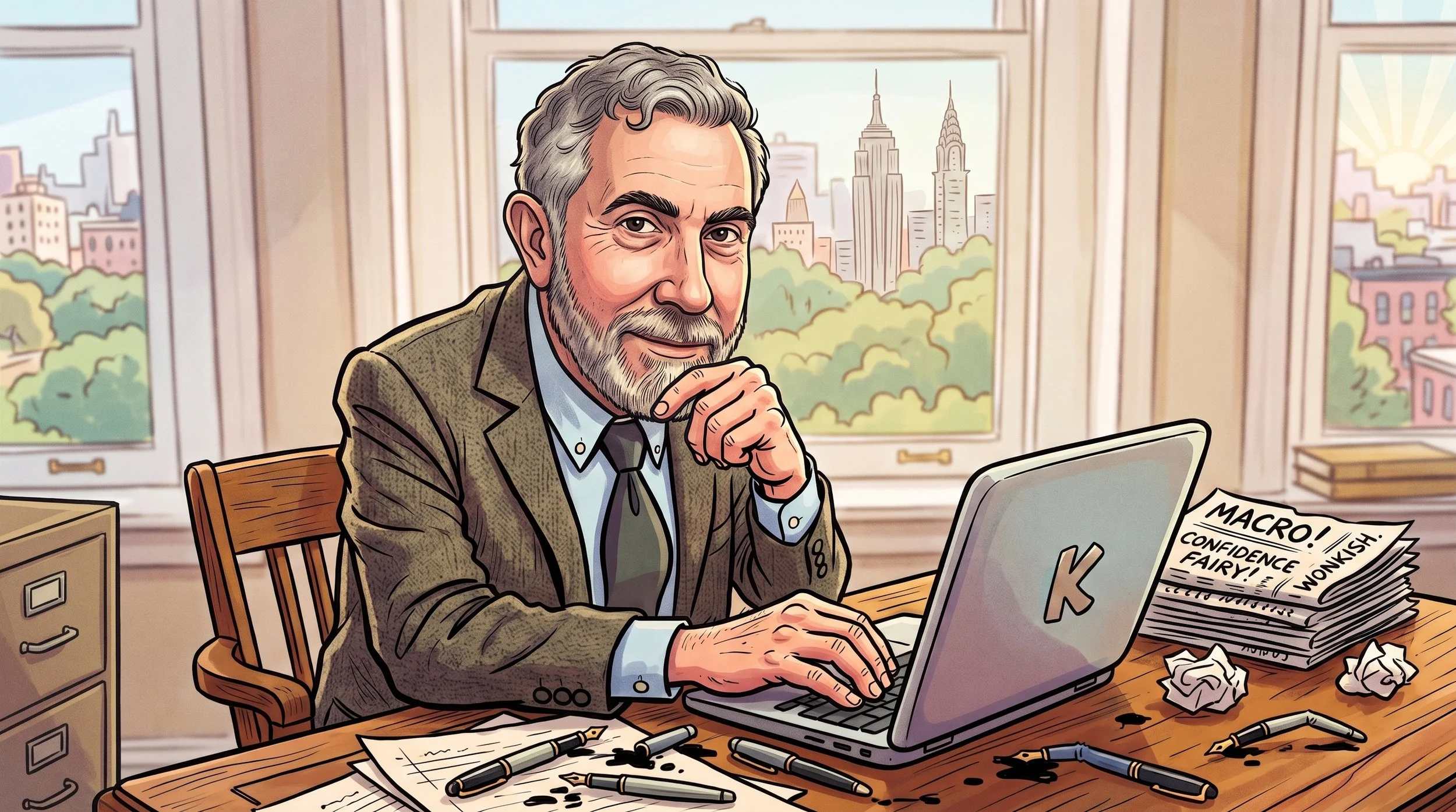
Image generated with Gemini
“The Conscience of a Liberal,” Paul Krugman’s blog at The New York Times, was once reason enough to subscribe to the paper. Of all American economists, Krugman is one of the few who is not afraid to speak with moral clarity about the ruinous path the Republican Party has taken and about the vulgarity of the Trump regime. For those who accuse The New York Times of being some kind of one-sided liberal outlet, it is worth noting that after 25 years of collaboration, Krugman decided to stop working with the paper because of growing editorial friction. In a few interviews, including this one with Noah Smith, he goes as far as to say that he felt his voice was being dulled.
His archive of columns at The New York Times is still available here for subscribers. It is a great corpus of work that includes his “popular” writing, covering everything from the Iraq war to the housing bubble to the austerity epidemic that took over European economic policy. He coined the term “confidence fairy” to describe the rationale behind the austerity obsession spearheaded by leaders such as Angela Merkel. The archive also includes the unedited blog that housed what he called his more “wonkish” writing, where he went deeper into the technicalities of his discipline. The merit of that work, as he puts it in this piece for The Contrarian, is that he was able to craft a style that boiled complex economic arguments down to their essentials, expressed them in ordinary language, and made them interesting for people outside his professional community.
His reason for leaving the Times is perhaps best explained in his own words at The Contrarian: “Also in 2024, the editing of my regular columns went from light touch to extremely intrusive. I went from one level of editing to three, with an immediate editor and his superior both weighing in on the column, and sometimes doing substantial rewrites before it went to copy. These rewrites almost invariably involved toning down, introducing unnecessary qualifiers, and, as I saw it, false equivalence. I would rewrite the rewrites to restore the essence of my original argument. But as I told Charles Kaiser, I began to feel that I was putting more effort—especially emotional energy—into fixing editorial damage than I was into writing the original articles. And the end result of the back and forth often felt flat and colorless.” The way I read it, it sounds as if the Times became scared of being the outlet that published a voice so loudly critical of the Trump administration: this conscientious liberal. The episode speaks volumes about the state of freedom of speech in the times of MAGA.
The good news is that there is no longer any need to subscribe to the Times to read most of his work. There is something bittersweet about the loss of the combined prestige that the Krugman–Times association brought to liberal voices. But it is great to know that Krugman is now writing freely and unedited on his own Substack, and that we can all read him without going through a paywall.