
Image generated with Gemini
Much has been said and speculated about the revelations that led to Jensen Huang's resignation from his chief executive role at Nvidia. Even his biographer, Stephen Witt, chipped in to paint the picture of a narcissist who couldn't tolerate dissent, framing his fall as a story of hubris.
While it is important to scrutinize and set limits on the behavior of CEOs, the over-personalization of the incident obscures an important corporate governance question raised by Huang’s departure. Consider the numbers. At the close on November 17, Nvidia was worth about $3.76 trillion and made up roughly 6% of the S&P 500, down from more than 8% in early October. Put differently, of every $100 a household puts into an S&P 500 index fund, about $6 rides on Nvidia's future.
Moreover, credible estimates indicate that approximately 76 million U.S. households (nearly six in ten households) own stocks, mutual funds, or ETFs. According to Gallup, roughly 156 million U.S. adults (58%) owned stock as of April 2026, mostly through funds and retirement accounts. Because the S&P 500 is the foundational benchmark for most 401(k) plans, target-date retirement funds, and core index ETFs, most of these households carry direct or indirect exposure to the index.
In other words, the fate of Nvidia matters not just to Wall Street, but to more than half of US households whose savings are very likely invested in the firm, directly or indirectly, and to retail investors around the world. This is why it's so concerning that Nvidia's board had, as far as anyone outside the boardroom can tell, no actionable succession plan to protect shareholder value in Huang's absence. It is an almost unforgivable omission for a publicly listed company of this magnitude and weight in the world economy.
What is succession planning?
Gartner defines it as "the process of identifying and developing internal talent to fill key leadership roles within an organization. It ensures business continuity, reduces the risk of leadership gaps and prepares the organization for future growth."
A true succession plan typically addresses at least the following two dimensions of key-person risk:
Emergency Succession (The Contingency Plan): Often called the "hit by a bus" scenario. This is a strictly operational, short-term protocol detailing exactly who takes over as interim CEO immediately if the current leader suddenly passes away, falls incapacitated, or exits without warning. Its primary goal is to stabilize the stock price, reassure institutional investors, and maintain daily operations.
Long-Term Succession (The Strategic Pipeline): A multi-year talent development framework. This involves the board actively assessing internal executives, rotating them through different high-stakes divisions to test their capabilities, and grooming a shortlist of permanent successors.
Aren't succession plans mandatory already?
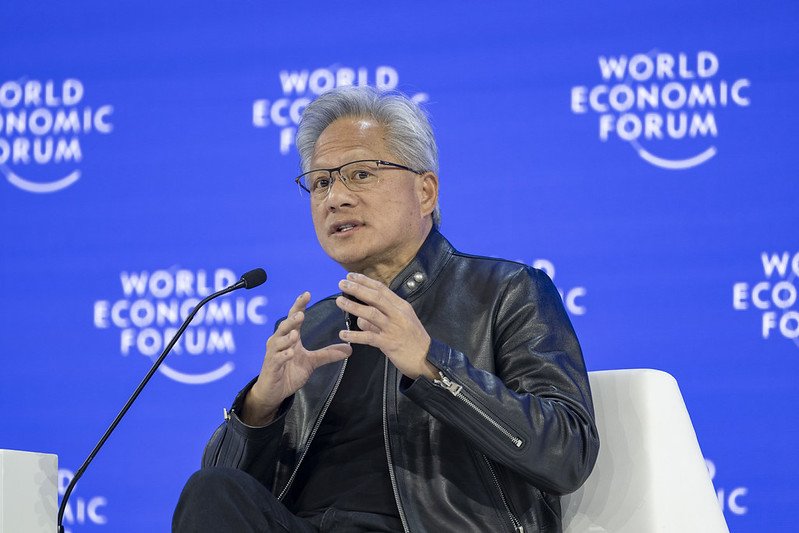
Photo shared by the World Economic Forum on Flickr, under a Creative Commons License.
One would be tempted to assume that stock exchanges require publicly listed companies, at least those that reach a certain size, to maintain succession plans for key individuals. Interestingly, the Nasdaq corporate governance requirements (Nasdaq 5600 series) applicable to both applicants and listed companies such as Nvidia, are completely silent about succession planning. This means that the Nasdaq essentially allows corporate behemoths to trade without a succession plan or even a minimum set of guidelines to mitigate the risk that one of their key executives passes away, falls incapacitated or exits abruptly. Nor has Nvidia filled the gap on its own: the next best thing you can find in Nvidia's Charter of the Nominating and Corporate Governance Committee of the Board of Directors, the body that would typically address succession plans, is a broad and self-referencing provision that tasks the members of the committee to "oversee the management of risks associated with the matters for which the Committee is responsible." It is ironic that Nasdaq, Inc. is so lax with the companies listed on its exchange while it sets the following role for its own board in its very own corporate governance guidelines: "the Board and its Committees oversee Nasdaq business affairs and integrity, review internal control over financial reporting, perform the annual Chief Executive Officer evaluation and oversee the Chief Executive Officer and other senior officer succession planning process".
The New York Stock Exchange seems to be slightly more cautious. In particular, Section 303A.09 of the NYSE Listed Company Manual requires listed companies to "adopt and disclose corporate governance guidelines"; its commentary adds that succession planning "should include policies and principles for CEO selection and performance review, as well as policies regarding succession in the event of an emergency or the retirement of the CEO." While the rule does not enshrine an express requirement for all listed companies to have a succession plan, it indirectly requires it by setting it as mandatory content for the governance guidelines that every listed company must adopt and disclose.
Still, NYSE's stance on this seems insufficient. Rule 303A.09 is essentially a disclosure rule that leaves it up to the market to enforce the adoption and maintenance of adequate succession plans. In fact, the real pressure on listed companies to maintain succession plans comes from proxy advisory firms (like ISS and Glass Lewis) and massive institutional shareholders (like BlackRock and Vanguard), who publish their own governance guidelines. If a board fails to demonstrate a robust succession pipeline, proxy advisers may recommend, and large investors may cast, votes against the responsible directors at the annual meeting. This policy approach to succession planning is a libertarian's dream in the sense that it relies on market standards, yet it essentially allows public companies with little institutional ownership (typically smaller companies) to continue to trade without succession planning.
Should succession planning be mandatory for public companies?

Photo by Anders Eidesvik under a Creative Commons License
Before the first reports of the Huang scandal broke on October 29, Nvidia's market valuation was sitting at more than $5 trillion. Following the initial reports, the subsequent revelations, and Huang's official resignation on November 12, the stock experienced a massive sell-off. As of mid-November, the company's valuation has dropped to around $3.8 trillion. That's a loss of roughly $1.4 trillion in shareholder value, though not all of it can be pinned on the scandal: chip stocks were selling off too.
While it's impossible to estimate the mitigation power that an actionable succession plan would have had in a case involving a suspected Chinese intelligence asset, the existence of an actionable plan for the succession of Jensen Huang would have given markets some reassurance that the board had a competent successor ready to step into his shoes. Without one, the board must now find a unicorn at full speed: Someone who has deep technical expertise in the field of artificial intelligence (including the hardware and all the other technologies required to support it), someone who is able to excel in what some Wall Street analysts have called the wheeling-and-dealing that Huang was so good at after building a complex network of partners, customers and suppliers and last but not least, someone who is a talent magnet, able to attract the best engineering talent on the planet. In many ways, the juncture cannot be thought of as a standard transition from a founder to a "professional CEO". Analyst Dan Ives has even said that Huang's involvement is worth $1 trillion to Nvidia's valuation story.
So, if Nvidia is Huang, as suggested by many commentators, it is extremely disappointing that the board did not insist on a succession plan that involved him in the "grooming" of his own successor. It calls into question whether succession plans should be mandatory for public companies.
While most academics agree that succession planning is critical, the question of whether it should be mandated by law is far from settled. Here are some of the most compelling arguments on both sides:
Arguments for mandatory succession planning
Massive Shareholder value destruction: The problem is not limited to Nvidia. A widely cited 2021 study published in the Harvard Business Review estimated that poorly managed CEO and senior-executive transitions wipe out close to $1 trillion in market value annually among S&P 1500 companies. The underlying idea behind this argument is that a risk that is so financially devastating should not be left to voluntary compliance or best practices but instead should be effectively regulated. The Huang case seems to vindicate this argument.
Overcoming the Agency Problem and Management Entrenchment: Succession planning is uniquely vulnerable to agency costs and managerial entrenchment. CEOs often resist succession planning due to ego, fear of losing control, or a desire to avoid "lame duck" status. Jensen Huang himself reportedly said that he hopes to "die on the job" and, in a March interview with Lex Fridman, that he does not believe in traditional succession plans. Ironically, the more successful, charismatic and indispensable CEOs are perceived to be, the harder it is for boards of founder-led companies to force the issue of succession planning. This is particularly the case in companies where the founders still keep effective control via dual share classes (such as Meta). A regulatory mandate would force the board's hand, depersonalizing the process and removing the friction of going against the wishes of a powerful CEO. It would give boards both the duty and the teeth to fulfill it.
A "Per Se" violation of fiduciary duties: Recent corporate law scholarship, notably Carrie Stanton's 2025 article "Scrutinizing Succession" in the Wisconsin Law Review, has argued that failing to maintain a reasonable, documented succession plan should be considered a per se violation of a board's fiduciary duties of care and loyalty. The proposal is that succession decisions should not be protected by the highly deferential "Business Judgment Rule," but should instead face enhanced judicial scrutiny given that leadership transitions create profound agency problems and entrenchment risks that inherently cloud a board's objectivity. Stanton points to the fact that Delaware courts already recognize that a potential change of control (like a merger) threatens directors' positions and therefore their objectivity. Succession planning, the argument goes, creates the same structural and psychological conflicts for board directors and therefore warrants the same enhanced standard of judicial review.
It already works elsewhere: Mandates are not a leap into the unknown. The UK Corporate Governance Code expects the nomination committee to ensure plans are in place for orderly succession to the board and senior management, on a "comply or explain" basis, and US bank regulators already require large banks' personnel programs to provide for orderly succession. These regimes show that a principles-based duty can coexist with board discretion, and that the choice is not binary between a rigid mandate and no rule at all.
Arguments against mandatory succession planning
The Crown Prince Problem: Other scholars (Donald Hambrick and Eric Lee, writing in Organization Science in 2025) model formal CEO succession planning as a risky investment, explicitly as a counterpoint to the view that it is always wise. They argue that boards that run these processes can create massive organizational disruption, rivalries and uncertainty. This can translate into "horse races" and toxic internal politics, especially when a board discloses that multiple internal executives are vying for the top spot, pitting them against one another and turning routine business decisions into political turf wars. Moreover, when a horse race concludes or when a succession plan is published, the individuals who are not named as "heirs" (often key executives themselves) may conclude that upward mobility is blocked and will be tempted to resign to seek CEO roles at other firms. Finally, subscribers to this line of thought contend that succession planning may also signal to the market and internal staff that the current CEO's tenure is ending and that their role is now that of a "lame duck", prematurely stripping them of their authority and causing stakeholders to bypass the incumbent and defer to the announced successor. While these are legitimate concerns, they assume that mandatory succession planning would also require some kind of highly publicized "horse race" where winners and losers are singled out and/or the incumbent CEO has no input. On the contrary, recent high-profile CEO successions that are thought of as exemplary (such as Apple's handover from Tim Cook to John Ternus) tend to show that incumbent involvement is desirable and that there is no need to create protracted and widely publicized horse races. A legal mandate for public companies to adopt and maintain succession planning for key executives does not need to be an obligation to hold ruthless, widely publicized corporate hunger games.
Infringement on the Business Judgment Rule: Strict defenders of the business judgment rule, such as Stephen Bainbridge, would likely respond that corporate law is built on the premise that boards of directors (not judges, SEC regulators or exchanges) are in the best position to manage the affairs of a company. In that light, mandating how and when a board must plan for leadership transitions constitutes regulatory overreach into the business judgment of the directors. This is not a particularly persuasive argument: There is plenty of regulation that constrains the judgement of corporate agents and is not perceived as an overreach into anyone's business judgement (think of antitrust regulation, for example, that compels executives to avoid collusion even if it makes "business sense"). Certain things, such as the exposure to outsized risks that could disproportionately affect retail investors and households, should not be left to the discretion of directors who may be unable or afraid to act as a check on executives. In general, this argument against mandatory succession planning reads like a libertarian slogan: The market embodied in the judgement of board directors knows better when a succession plan is needed.
The risk was disclosed, and priced in: Nvidia has flagged succession planning as a risk factor in its annual reports since 2018, and since 2022 its 10-K has stated that the company is "highly dependent on the services of our longstanding executive team." On this view, investors bought a founder-led company with their eyes open, the key-person discount was already in the price, and disclosure, not a mandate, is the right tool. The weakness of this argument is that it assumes all investors can act on what is disclosed, which is not always the case for indirect investors, who have stakes on blue chip companies through index funds.
The requirement may be too onerous for smaller companies: This consideration carries a lot of weight. Smaller companies may find it too onerous to comply with complex succession planning requirements and their leadership transitions are arguably not as consequential for the market as whole. This is why any regulation mandating succession planning must be carefully designed. It should consider some kind of de minimis criterion that exempts companies whose leadership transitions will not cause significant effects in the market and it should be accompanied by industry-agnostic standards that fix reasonable minimum requirements for succession planning beyond mere paper-compliance. It should also be modulated to avoid the risk that succession planning exercises become hunger games that result in the loss of talent. Given how hard it will be to enforce these rules, the regulation should unequivocally set succession planning as a fiduciary duty for too-big-to-fail companies, both ensuring that the SEC (or analogous regulators outside the US) have sufficient teeth to scrutinize succession planning and opening the door for shareholders (especially minority shareholders) to enforce the requirement by suing boards of directors who breach their succession duties and cause them damage.
All in all, I tend to think that there is a good case for mandating succession plans to corporate behemoths. In a world where nearly a tenth of the S&P 500 is tied to three men with no successors and dual-class share structures abound, we all have a stake in the enforcement of sound corporate governance practices. We should all advocate for a corporate world that is not overly reliant on king-like CEOs who have an incentive to make themselves irreplaceable. Great leaders will most certainly be eager to ensure orderly successions that do justice to their talent. No blue-chip CEO should be too indispensable, too big or too well connected to sack.