Owner's Review: Nine Years With The Batman - The Rolex GMT-Master II BLNR - Mark I
An honest owner's review of the Rolex 'Batman', after nine years in the rotation
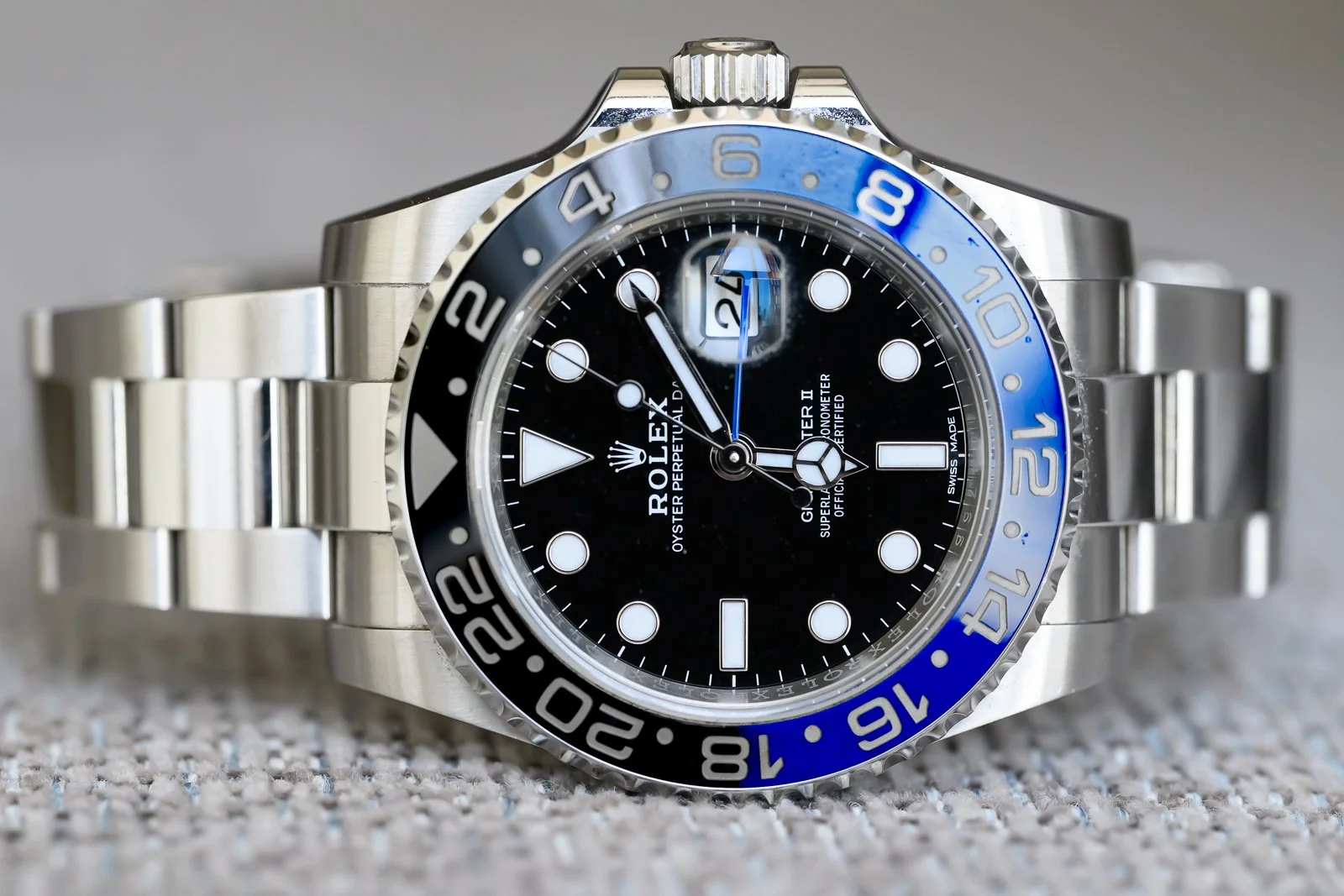
So, this was my first Rolex. Back when I bought it in 2017, it wasn't nearly as hard to get as it is today. I remember seeing it once at a Rolex Boutique in Charles de Gaulle at duty free prices, that is: slightly below retail. I ended up buying it from Bucherer in Germany, which still supplies me with all kinds of "impossible" watches.
Some context first: Rolex did not invent the idea of showing a second time zone, but it did create the template for the contemporary GMT with the GMT-Master (ref. 6542) developed jointly with Pan Am around 1954. That watch, (which is one of my grail watches in its Pepsi bakelite incarnation) had a separate fourth hand running once every 24 hours set against a 24-hour bezel, which allowed the wearer to read home time and destination time at a glance.
Many improvements have been made since that first iteration, including a ceramic bezel, the ability to jump to a destination time without stopping the movement and a quick-change date, but more than 70 years later the design language and the GMT-Master DNA are still well alive and kicking. For many collectors, the Rolex GMT-Master II (its current incarnation) is the GMT par excellence, the one that all other GMTs must be compared against.
What many people don't know is that this Mark I version with a blue and black bezel was born out of some kind of necessity. Back in 2005, when the GMT line moved to ceramic bezels, a two-tone single-piece ceramic bezel was widely considered impossible. Rolex cracked it in 2013 with the blue-and-black bezel we now know as the Batman. Red proved harder: the Pepsi followed in 2014, and only in white gold. A steel Pepsi didn't return until 2018. While I am certain that I will add a Pepsi to my collection one day, I tend to think that the BLNR is much easier to wear in casual settings.
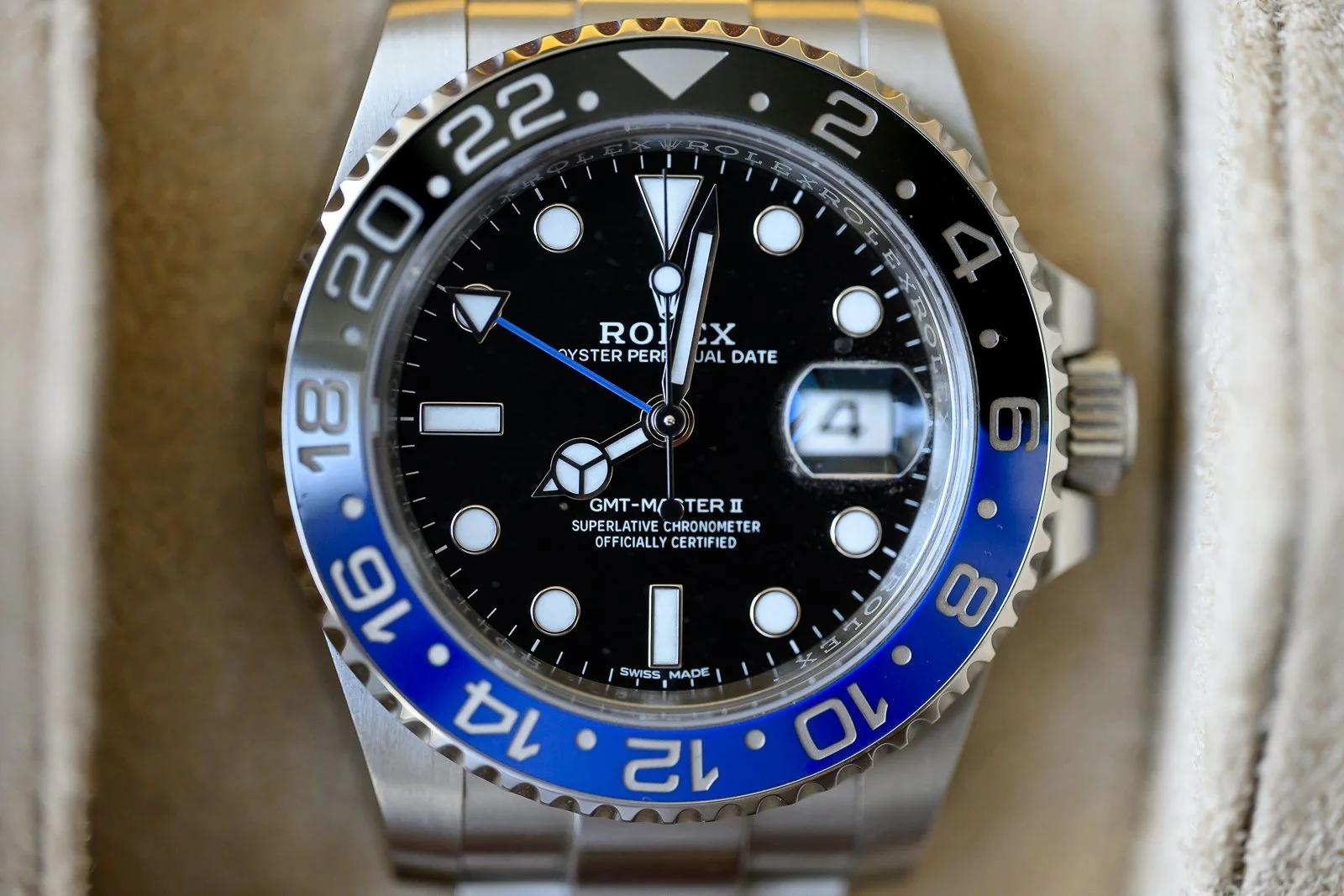
The Mark I (ref. 116710BLNR, 2013–2019) has three main differences from the current Mark II (ref. 126710BLNR). The most important one is the movement: the Mark I runs the calibre 3186, while the Mark II moved to the newer calibre 3285. The latter adds Rolex's Chronergy escapement and stretches the power reserve from about 48 to 70 hours. Both beat at 28,800 vph, use a blue Parachrom hairspring and are certified to −2/+2 seconds a day. The other two differences are mostly cosmetic: You can get the Mark II on a Jubilee bracelet (the Oyster returned as an option in 2021), and later Mark II dials have a small crown between the words Swiss and Made at 6 o'clock.
I remember being slightly underwhelmed by it when I first bought it. At the time, I felt that there was something too metallic about Rolexes, and the Oyster bracelet with mirror-polished center links seemed a bit too shiny and prone to scratches. From the outset, my favorite aspect of it was the color of the GMT hand, which I remember a watch commentator referring to as finger-licking blue or something of the like.
And then I started travelling with it. And it turns out that this watch is an amazing travel companion (unless you plan to take it to one of those cities where folks will steal it from you even if that means chopping your hand). There is something insanely practical about jumping on the airplane, pulling out the crown and simply making the Mercedes hour hand jump to your destination's time without stopping the movement or resetting anything else. It is such a useful complication that it makes a point in favor of complicated mechanical wrist watches: even with a digital screen, you could hardly think of a neater or cleverer way to show two time zones at once.
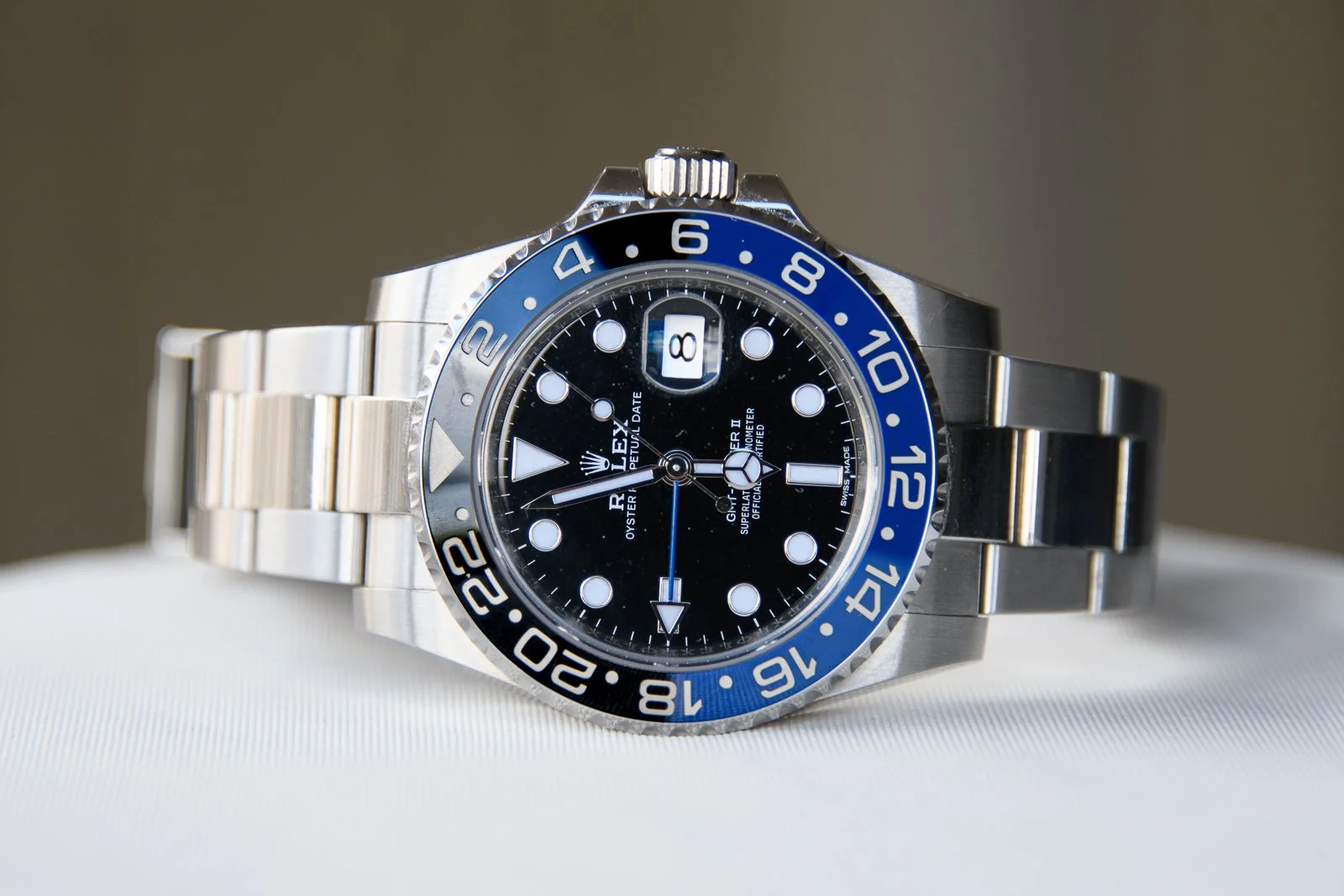
The watch has grown on me across the years. I have developed a real appreciation for the toolish no-nonsense black maxi dial just sufficiently (not too much, not too litte) decorated by the white-gold applied markers. The numbers inside the cyclops window look insanely crisp against the pristine white background, as if to prove that nobody does date windows better than Rolex. The case that felt rather small for a guy who wore 42mm Speedmasters and Omega Planet Oceans now feels perfect: Not too bulky, easily wearable, but sufficiently present on my wrist to make it clear that I am wearing one of the most coveted watches from the most famous watch brand on the planet.
Finally, something has to be said about the accuracy and robustness of calibre 3186. After tracking it across my last 244.4 days of wear using Watchtracker, it has kept an astounding deviation of only +0.7 seconds per day on average, which allows me to conclude after 9 years of ownership and exactly zero visits to servicing, that it is my most accurate watch. I think John Mayer was spot on when he said that it is one of the best modern movements Rolex makes in the first ever episode of Hodinkee's now legendary Talking Watches series, back in September 2013. He also said that it is the best contemporary watch that Rolex makes. I was very lucky to get mine as my first Rolex in 2017. It is probably safe to say that it will never leave my collection.
Who is this watch for?
I would say this is a perfect watch for frequent travelers who don't need to wear dressy watches and whose common destinations are not those cities that ooze with thieves trying to find Rolexes and Pateks to snatch.
Pros
The GMT complication is extremely useful and Rolex's rendition is probably the best there is. Thanks to the independent jumping hour hand, you can switch to your destination's local time without stopping the movement, while the GMT hand keeps pointing to home. It makes the watch a great travel companion.
The black maxi-dial has insane toolwatch charm. It is simple and utilitarian but it is also nicely decorated with 18k white gold indexes. It feels quintessentially Rolex.
The 40mm case (12.5mm thick) has near perfect dimensions. It is not too bulky to be intrusive but also not too small to be puny. Given that it is a traveler's watch, the case strikes the right balance between wearability and wrist presence.
While the Pepsi bezel is the icon, this one is much more wearable in casual/business settings.
You're not just buying a GMT; you're buying the watch that set the standard for the complication.
It's an insanely accurate and robust timekeeper. I have not serviced it since I bought it 9 years ago and in the last 244 days of wear it kept an average deviation of +0.7 seconds/day.
Cons
The Mark I has only 48 hours of power reserve. The Mark II goes as high as 70. Take it off on Friday night and it will have stopped by Sunday.
The Oyster bracelet with mirror polished centerlinks is a scratch magnet. It has grown on me over the years, but it feels slightly fragile for a traveler's watch.
People will try to steal it from you in most cities. It is highly coveted and easily recognizable.
Specifications
Reference: 116710BLNR (Mark I), produced 2013–2019
Case: 40 mm Oystersteel, screw-down Triplock crown, water-resistant to 100 m
Bezel: bidirectional rotatable 24-hour bezel, blue-and-black Cerachrom insert
Dial: black, 18k white gold applied indexes with Chromalight luminescence
Crystal: sapphire with Cyclops lens over the date
Movement: calibre 3186, automatic, 28,800 vph, about 48 hours of power reserve, blue Parachrom hairspring, Superlative Chronometer
Functions: hours, minutes, seconds, date, 24-hour GMT hand, independently set hour hand
Bracelet: Oyster, Oysterlock folding clasp with Easylink extension